Community
Share your thoughts, experiences or questions and participate in discussions over our favorite topic : SCUBA diving!
Coral Reef Spawning : Now in Australia
by Ksso on March 30, 2011

As Wikipedia states, (in case you don't know what a coral is):Coral reefs are underwater structures made from calcium carbonate secreted by corals. Corals are colonies of tiny living animals found in marine waters that contain few nutrients. Most coral reefs are built from stony corals, and are formed by polyps that live together in groups. The polyps secrete a hard carbonate exoskeleton which provides support and protection for the body of each polyp. Reefs grow best in warm, shallow, clear, sunny and agitated waters. Also, a coral reef is a reef consisting of coral consolidated into limestone. ...
Big Women Really Are Fun
by Ksso on March 27, 2011

Before getting in the water you need to perform a full body check with your dive buddy. This sentence "Big Women Really Are Fun" is my way of remembering how to do it properly without forgetting anything :
B(ig) - BCD : check out your buddy's BCD , how it attaches, how it works (especially in case if you need to grab him and get him to the surface safely, you'll need to be able to controle your buddy's buoyancy
W(omen) - Weight : check the weight belt, right hand release, no nested straps
R(eally) - Regulators : check the position of the safety additional regulator and ensure that nothing blocks or slows access to it ...
Fish round up : Sea Cucumbers
by Ksso on March 27, 2011

Sea cucumbers are a common oddity in the ocean's sandy bottom. While they look like a dead dark sausage, they're actually live animals. They're even harvested for their skin and muscles to China. Alaskan sea cucumbers are also apparently more nutritionally interesting than their chinese counterparts.Sea cucumbers reproduce releasing sperm and ova in the sea - a subset of species fertilize their eggs internally. They also communicate one with another releasing hormons.Wikipedia precises that sea cucumbers have no true brain. A ring of neural tissue surrounds the oral cavity, and sends nerves to the tentacles and the pharynx. The animal is, however, quite capable of functioning and moving...
The underwater photographer
by Ksso on March 22, 2011

I love to take underwater pictures, but let's face it, although technology got more affordable, it's awfully complicated to take decent underwater pictures. I recently got my hands on that book by Martin Edge, the Underwater Photographer, which really did help me understand better the whereabouts of underwater photography, including why it's so hard. Here are a few quotes that I'll try to keep in mind from now on :(...) the density of water is 800 times that of air. Such is the density of water, in fact, that people compare a picture taken in 0.5 m of water with a picture on land taken at 800 m away.Getting as close as possible, physically, is often all it needs to produce a marked...
Fish round up : Harlequin Shrimp
by Ksso on March 19, 2011

Couldn't resist to share another incredible pic by Doug.Deep. Harlequin shrimp are fairly tough to spot, since the only live in the Pacific Ocean (and even there they're not ultra-common as the obis map below shows). It may actually be easier to spot them in a sea aquarium since this specie is also "cultivated" and fairly easy to buy in any aquarium shop (a quick google search shows a pair retailing 69.99USD).Contrary to what obis shows, there is also a hawaian harlequin shrimp, which differs from the pacific one by being more shy and hiding in dark spots.The appearance of the harlequin shrimp isn't the only aspect that sets them apart from other shrimp. They have a truly unique diet as...
Donate for Japan
by Ksso on March 15, 2011

What's happening now in Japan goes beyond imaginable. Reactor meltdowns, quakes, radioactive contamination, tsunamis, thousands of deaths ... this all sounds like a bad drama.... yet this time it's real.I won't even talk about the consequences to the ecosystem, as you may remember from the last tsunami that hit Indonesia, those waves do harm the ecosystem, but the impact of a heavy dose of radiation are not well known.Anyway it's time yo support the Japanese Red Cross in their tentative of helping out the people there and donate. If you want to make sure your funds go to the Japanese red cross, you can either do a money transfer or use this form and google checkout.
Sea wonders : White christmas tree worm
by Ksso on March 12, 2011

Like for the slugs, the worms under the sea are way cooler than their earthy counterparts. The "Sabellida" order is composed by plethora of variations around the sea worm theme. Those worms hide in a tube (like the trunk of a tree) and anchor themselves onto living coral or rocks thus being sedentary. The head is mostly concealed by feathery branchiae. As sedentary inhabitants of coral reefs, tree worms feed primarily by filter feeding.Whenever they sense unusual current or presence, they withdraw all the radioles (the feather-like tentacles) inside the tube.Most species are not hermaphrodite and produce eggs that are fertilized externally and turn into larvas that hunt for a sweet spot...
Fish round-up : the Grouper
by Ksso on March 09, 2011

In many places, seeing a grouper is kind of a huge achievement, and the bigger the grouper the better. Groupers can size over a meter and weight over 100kg, so when bragging about the grouper you've spotted you can be pretty pushy (but remember the rule: no picture, no proof => it did not happen ! ). The "giant grouper" can even grow up to 2.7m (8.9ft) and 600kg (1300lbs), but he can only be spotted in Madagascar, Indonesia and Australia and apparently not very easily...Groupers are usually laying still near rocks, and their grey spotted skin combined to their stillness makes them actually fairly hard to spots. They don't like humans so much so as soon as they understand you've grown...
Sea wonders : nudibranchs
by Ksso on March 03, 2011
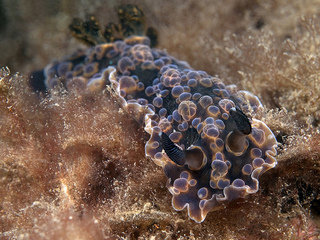
Nudibranchs are also known as "sea slugs". Yet contrary to their earthy counterparts they come on a wide range of shapes and colors. They get especially amazing in warm shallow water, making them even easier to go meet. Their amazing colors are actually a defense mechanism against potential predatorsNudibranchs can size from 2 to 60cm (0.79 to 24 in). Most of them are carnivorous eating things like sponges, some can even be cannibals and eat other sea slugs. Nudibranchs are hermaphrodite, and while they do bear both organs, they still need to mate to procreate.While nudibranchs won't attack you, some may hurt you by secreting an acid on their skin if you try touching them.
Hot or not ? the Thermocline
by Ksso on March 01, 2011
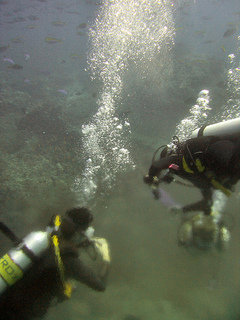
The thermocline is something you get to know soon enough when you're a scuba diver - the effects on the environments are extremely easy to spot : water below you becomes blurry and suddenly temperature drops by a couple degrees, enough to get you a chill. Move up a few centimeters above the blur, the water is hot again. The blur is actually caused by the altered refractive index of the cold or warm water column. This heat barreer is called the thermocline.A definition (by Weatherfacts) would be : The thermocline (gr: thermo = hot and clino = slope) is generally a steep gradient of rapid temperature change, but applied more particularly to a layer, in a body of water, in which the...
Share your experiences, thoughts, or ask a question |
| WRITE A POST |
Latest Questions
Join Diveboard

Categories
Latest Posts
 Help Test The New Diveboard And Raise More Funds!
by Ksso on April 25, 2023 Getting Ready For Diveboard V2 Join Our Discord
by Ksso on September 08, 2021 Scorpion Fish Identification: Stonefish Vs Devil Vs Scorpionfish
by The Smiling Seahorse on February 08, 2021 Best Online Ressource For Fish & Critters Identification
by The Smiling Seahorse on October 05, 2020 Try Out The Beta Android App
by Ksso on August 28, 2020
Older Posts
- April 2023 (1)
- September 2021 (1)
- February 2021 (1)
- October 2020 (1)
- August 2020 (1)
- November 2018 (1)
- June 2017 (1)
- May 2017 (3)
- April 2017 (2)
- March 2017 (1)
- May 2016 (1)
- April 2016 (1)
- February 2016 (1)
- January 2016 (1)
- December 2015 (1)
- November 2015 (2)
- July 2015 (1)
- June 2015 (4)
- May 2015 (2)
- April 2015 (3)
- February 2015 (1)
- January 2015 (2)
- December 2014 (1)
- November 2014 (1)
- October 2014 (5)
- September 2014 (5)
- August 2014 (2)
- July 2014 (2)
- June 2014 (5)
- May 2014 (6)
- April 2014 (5)
- March 2014 (7)
- February 2014 (1)
- January 2014 (5)
- December 2013 (2)
- November 2013 (5)
- October 2013 (2)
- September 2013 (5)
- August 2013 (7)
- July 2013 (7)
- June 2013 (10)
- May 2013 (1)
- April 2013 (3)
- March 2013 (1)
- February 2013 (2)
- January 2013 (5)
- December 2012 (2)
- November 2012 (8)
- September 2012 (1)
- August 2012 (2)
- July 2012 (3)
- June 2012 (1)
- May 2012 (3)
- April 2012 (1)
- March 2012 (7)
- February 2012 (1)
- January 2012 (5)
- December 2011 (3)
- November 2011 (3)
- October 2011 (8)
- September 2011 (3)
- August 2011 (11)
- July 2011 (4)
- June 2011 (8)
- May 2011 (13)
- April 2011 (6)
- March 2011 (10)
- February 2011 (15)
- January 2011 (9)
BCommunity Feed
Community blog posts rRSS feed
 We are participating today in the startup contest Techcrunch Disrupt. Support Diveboard by voting for us!