Community
Share your thoughts, experiences or questions and participate in discussions over our favorite topic : SCUBA diving!
Fish round up : Harlequin Shrimp
by Ksso on March 19, 2011

Couldn't resist to share another incredible pic by Doug.Deep. Harlequin shrimp are fairly tough to spot, since the only live in the Pacific Ocean (and even there they're not ultra-common as the obis map below shows). It may actually be easier to spot them in a sea aquarium since this specie is also "cultivated" and fairly easy to buy in any aquarium shop (a quick google search shows a pair retailing 69.99USD).Contrary to what obis shows, there is also a hawaian harlequin shrimp, which differs from the pacific one by being more shy and hiding in dark spots.The appearance of the harlequin shrimp isn't the only aspect that sets them apart from other shrimp. They have a truly unique diet as...
Sea wonders : White christmas tree worm
by Ksso on March 12, 2011

Like for the slugs, the worms under the sea are way cooler than their earthy counterparts. The "Sabellida" order is composed by plethora of variations around the sea worm theme. Those worms hide in a tube (like the trunk of a tree) and anchor themselves onto living coral or rocks thus being sedentary. The head is mostly concealed by feathery branchiae. As sedentary inhabitants of coral reefs, tree worms feed primarily by filter feeding.Whenever they sense unusual current or presence, they withdraw all the radioles (the feather-like tentacles) inside the tube.Most species are not hermaphrodite and produce eggs that are fertilized externally and turn into larvas that hunt for a sweet spot...
Fish round-up : the Grouper
by Ksso on March 09, 2011

In many places, seeing a grouper is kind of a huge achievement, and the bigger the grouper the better. Groupers can size over a meter and weight over 100kg, so when bragging about the grouper you've spotted you can be pretty pushy (but remember the rule: no picture, no proof => it did not happen ! ). The "giant grouper" can even grow up to 2.7m (8.9ft) and 600kg (1300lbs), but he can only be spotted in Madagascar, Indonesia and Australia and apparently not very easily...Groupers are usually laying still near rocks, and their grey spotted skin combined to their stillness makes them actually fairly hard to spots. They don't like humans so much so as soon as they understand you've grown...
Sea wonders : nudibranchs
by Ksso on March 03, 2011
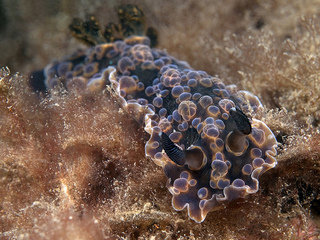
Nudibranchs are also known as "sea slugs". Yet contrary to their earthy counterparts they come on a wide range of shapes and colors. They get especially amazing in warm shallow water, making them even easier to go meet. Their amazing colors are actually a defense mechanism against potential predatorsNudibranchs can size from 2 to 60cm (0.79 to 24 in). Most of them are carnivorous eating things like sponges, some can even be cannibals and eat other sea slugs. Nudibranchs are hermaphrodite, and while they do bear both organs, they still need to mate to procreate.While nudibranchs won't attack you, some may hurt you by secreting an acid on their skin if you try touching them.
Fish round up : moray eel
by Ksso on February 28, 2011
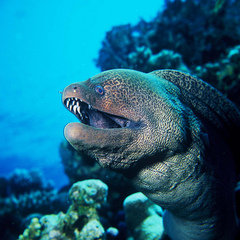
The moray eel has give my my first underwater adrenaline rushes while I was still training on my CMAS 1*. Luckily we've got a couple of those in the Mediterranean sea usually hiding below the thermocline, thus requiring a little bit of skill to get to see them, first to get to their depth (around 20m and up to several hundred meters), second some level of stillness to no scare them up.Moray eels can range from 11.5cm to 4m (4.5 in to 13ft). They eat small fish and have 2 sets of jaws stuffed with teeth, second one being in their throat that they launch into the mouth to catch the prey. Their teeth are often angled towards the throat, so anything that goes within that mouth is bound to go...
Fish round up : The prehistoric Coelacanth
by Ksso on February 23, 2011

Life origins from the oceans, that's something we've all learned at school. We also learned that at some point during the evolutions fish started wandering on the firm ground and got new appendixes to help them move on the ground more easily.The coelacanth (pronounced SEEL-uh-kanth) was thought to be extinct since the cretaceous period ( 70 to 140 million years ago). They are considered to be the link between the fish and the tetrapods (all things four-legged). With much surprise one specimen was fished in 1938 off the east coast of south africa and scientists discovered that the species is still present but only migrated to deeper water. Subsequently, a second species was fished in 1998...
Fish round up : the Sperm Whale
by Ksso on February 16, 2011

Sperm Whale Encounter from Howard Hall on Vimeo.
The sperm whale, also known as the common cachalot, can grow 20.5 meters long (67 ft), is the largest living toothed animal. The head can take up to one-third of the animal's length giving him the lagest brain of any animal on earth. It can live for 70 years.The sperm whale emits clicking vocalizations but while it's the loudest sound produced by any animal its function remains uncertain.It has been widely hunted between the 18th and late 20th century for the spermaceti (a white substance found in the animal's head and giving him the name), sperm oil and ambergris (a biliary secretion ) it produces and which are used in the perfume and...
Fish round up : the Cuttlefish
by Ksso on February 13, 2011

Contrary to its name, the Cuttlefish is a mollusk of the class Cephalopoda (just like the Squid and Octopus). The Cuttlefish is fairly widespread and can be easily spotted in Europe and Asia. The Cuttlefish has only one "bone", the cuttlebone, which works as an internal shell. They range from 15 to 25cm (5.9 to 9.8in)The Cuttlefish is fairly remarkable by its ability to change its skin color in seconds, just like a chameleon. He can do so either as a camouflage or as a means to communicate with fellow cuttlefish. Their skin is made of groups of red, yellow, brown, and black pigmented chromatophores above a layer of reflective iridophores and leucophores at a resolution of 359 DPI -...
Laser sizing
by Ksso on February 11, 2011

Classic conversation after a dive :
Diver1 : Have you seen the grouper - it was huuuuge ! almost 2 meters long ! (note : that's unlikely ). Check out the pic I took !Diver2 : Bull***** - You kiddin', that's more like 20cm tops...
Now, there's a real point in that conversation : evaluating the proper size of something underwater wether it's a fish, a wreck or a cave, is quite complicated. And the pictures taken do miss scale to enable proper evaluation of the subject size.Working with the University of Queensland, the Marine Megafauna Foundation and CSIRO Marine and Atmospheric Research, a team of researchers led by Chris Rohner has come up with a new technique to add a scale to underwater...
Fish mondays : the Pufferfish (& the Fugu)
by Ksso on February 08, 2011

The Pufferfish ( scientific name : Tetraodontidae) is a fairly common fish that can be encountered especially easily on the US , Australian and western African coasts. The Puffer fish can be also referred ad balloonfish, blowfish, bubblefish, globefish, swellfish, toadfish, toadies, honey toads, sugar toads, and sea squab and represents a family of about 121 species within 20 genera.The blowfish eat mostly crustaceans and mollusks whose shells they crush with their four teeth (thus the scientific name).Puffer fish are generally believed to be the second–most poisonous vertebrate in the world, after the Golden Poison Frog. One of its best known representant is the japanese Fugu fish which...
Share your experiences, thoughts, or ask a question |
| WRITE A POST |
Latest Questions
Join Diveboard

Categories
Latest Posts
 Help Test The New Diveboard And Raise More Funds!
by Ksso on April 25, 2023 Getting Ready For Diveboard V2 Join Our Discord
by Ksso on September 08, 2021 Scorpion Fish Identification: Stonefish Vs Devil Vs Scorpionfish
by The Smiling Seahorse on February 08, 2021 Best Online Ressource For Fish & Critters Identification
by The Smiling Seahorse on October 05, 2020 Try Out The Beta Android App
by Ksso on August 28, 2020
Older Posts
- April 2023 (1)
- September 2021 (1)
- February 2021 (1)
- October 2020 (1)
- August 2020 (1)
- November 2018 (1)
- June 2017 (1)
- May 2017 (3)
- April 2017 (2)
- March 2017 (1)
- May 2016 (1)
- April 2016 (1)
- February 2016 (1)
- January 2016 (1)
- December 2015 (1)
- November 2015 (2)
- July 2015 (1)
- June 2015 (4)
- May 2015 (2)
- April 2015 (3)
- February 2015 (1)
- January 2015 (2)
- December 2014 (1)
- November 2014 (1)
- October 2014 (5)
- September 2014 (5)
- August 2014 (2)
- July 2014 (2)
- June 2014 (5)
- May 2014 (6)
- April 2014 (5)
- March 2014 (7)
- February 2014 (1)
- January 2014 (5)
- December 2013 (2)
- November 2013 (5)
- October 2013 (2)
- September 2013 (5)
- August 2013 (7)
- July 2013 (7)
- June 2013 (10)
- May 2013 (1)
- April 2013 (3)
- March 2013 (1)
- February 2013 (2)
- January 2013 (5)
- December 2012 (2)
- November 2012 (8)
- September 2012 (1)
- August 2012 (2)
- July 2012 (3)
- June 2012 (1)
- May 2012 (3)
- April 2012 (1)
- March 2012 (7)
- February 2012 (1)
- January 2012 (5)
- December 2011 (3)
- November 2011 (3)
- October 2011 (8)
- September 2011 (3)
- August 2011 (11)
- July 2011 (4)
- June 2011 (8)
- May 2011 (13)
- April 2011 (6)
- March 2011 (10)
- February 2011 (15)
- January 2011 (9)
BCommunity Feed
Community blog posts rRSS feed
 We are participating today in the startup contest Techcrunch Disrupt. Support Diveboard by voting for us!